|
ENG
The series of
40
paintings exhibited at the exhibition "From Morandi to
Trevisan" at the Trevisan Art gallery in Verona is inspired by the
famous still lifes painted by Giorgio Morandi in his long artistic
career. In 2009, the Metropolitan Museum of Art in New York (MET) and
subsequently the Museum of Modern Art in Bologna (MAMbo) organized an
important exhibition dedicated to Morandi, offering the public a vast
and complete review of paintings never before dedicated to the
artist's work, presenting works from precious private collections
never exhibited. It was during the visit to this exhibition in
February 2009 in Bologna that Trevisan discovered the true depth of
Morandi's work, remaining enraptured and attracted by it.
In 1998 Trevisan wrote in his "Synthesis of a Manifesto": "... I have
never created a still life. Every object has its own life. Whether
this is animated or not depends on our ego. Every object is in itself
a living entity. Your soul, our life, our experiences, our habits
associate a simple object with its own life."
In fact, Trevisan's painting began immediately in the nineties in a
surreal key.
And he remains faithful to this dreamlike vision in his long artistic
work, slowly and step by step carrying forward his own artistic vision
of life.
His surrealism is inspired by Chagall and Magritte, masters of
reference from the beginning, who with their dreamlike and dreamy
vision come close to his artistic conception.
Objects, animals, people fly light and suspended, without gravity,
without gravitational horizons. in his works, taking the observer's
dreams by the hand to relieve him of everyday life and earthly and
material superficiality. Trevisan came from many years of photographic
work that helped him with framing and proportions of subjects and
objects, treating everything as a composition of a scene where
everything finds balance and harmony.
We must not forget his technical and scientific training that we
certainly find in the structure of each pictorial work;
in each painting it is easy to find a structure with foundations on
which the work develops.
Symmetry and balance help both in the implementation phase of the
painting and at a later stage when the completed work remains over
time a cornerstone of Trevisan's art. And it is precisely this balance
that Trevisan finds in Morandi's work.
A static
nature
of the elements that appropriate their simple and archaic geometries
to arrive at a lyricism that becomes color and poetry. A key to
reading and action that Trevisan captures in Morandi's works and that
immediately opens his eyes to an unequal vision of the composition of
the pictorial work.
Trevisan grew up and studied in the city of Piero della Francesca and
he took from the Renaissance and Tuscan art the basic elements that
shaped and raised him in these lands of art and culture.
Later, it is Versilia that influences and structures his artistic
vision and in the pictorial representation the imprint of the figure
of the poet is constant, which often seems to prevail over that of the
painter, so much so that each work becomes a lyrical synthesis of a
deep and intense world. Trevisan lyricism with which he approaches
Morandi's themes with ease and mastery.
But Trevisan is an artist of this time with an artistic experience of
twenty years and cannot stop at the pure and simple chromatism of
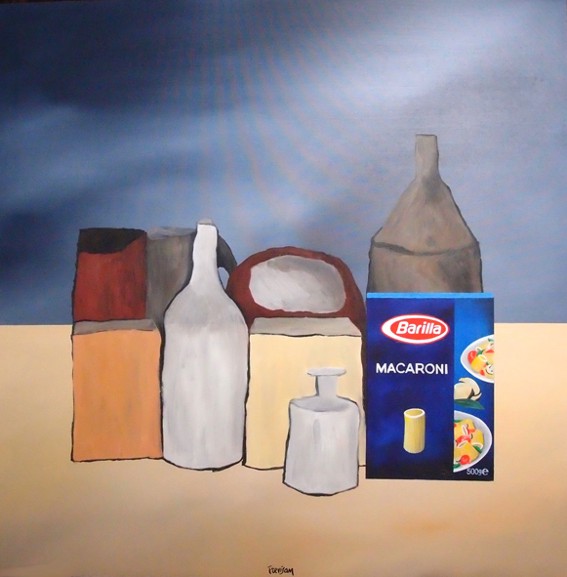
Morandi. So the old bottles and boxes of Morandi's paintings, stripped
of their lyricism of timeless humility, are flanked by the vivacity
and chromatism of brand products of famous fashion brands, drinks,
design objects that speak of our time. In a contrast between past and
present, the composition harmonizes with the domestic and familiar
theme of the diner;
vessels of yesterday and tomorrow seen as a transfiguration of a
painting that is filled with heavy brushstrokes in the style of
Morandi as well as in the delicate and meticulous ones of Trevisan. In
Morandi's elementary volumes, the colored shapes of the new elements
perfectly facilitate the union of the different elements. The
backgrounds remain the original Morandi ones that give the pictorial
austerity to the work on which the colored volumes stand out, almost
overlapping in a different level of the canvas plane.
The view of the geometric composition is balanced in respect of the
geometric spaces (everything is enclosed in a rectangle with a base
double the height) and in a study of the golden section, so as to
harmonize the past and the modern in a single and unique protagonist
subject.
Trevisan's series of still lifes is therefore not a tribute to the
Bolognese painter, but rather a continuation of that lyrical language
that life must find in the simplicity of a composition of everyday
objects, abstract containers of emotions and suggestions, often in a
contrast of visions that however well reflect contemporary society and
life.
ITA
La
serie di 40 dipinti esposti in occasione della mostra "Da Morandi a
Trevisan" presso la galleria Trevisan Art in Verona è ispirata alle
famose nature morte dipinte da Giorgio Morandi nella sua lunga
carriera artistica.
Nel
2009 il Metropolitan Museum of Art di New York (MET) e successivamente
il Museo d'Arte Moderna di Bologna (MAMbo) realizzano un'importante
mostra dedicata a Morandi, offrendo al pubblico una rassegna vasta e
completa di dipinti mai dedicata all'opera dell'artista, presentando
opere provenienti da preziose collezioni private mai esposte.
E'
durante la visita di questa mostra nel febbraio del 2009 a Bologna che
Trevisan scopre il vero spessore dell'opera di Morandi, rimanendone
rapito e attratto.
Nel
1998 Trevisan scriveva nel suo "Sintesi di un Manifesto": "...non
ho mai realizzato una natura morta. Qualsiasi oggetto ha di per se una
sua vita. Che questa sia animata o meno dipende dal nostro io. Ogni
oggetto è di per sé un ente vivo. Il vostro animo, la nostra vita, le
nostre esperienze, le nostre abitudini associano ad un semplice
oggetto una sua vita."
Infatti la pittura di Trevisan esordisce da subito negli anni novanta
in chiave surreale. E a tale visione onirica egli rimane fedele nel
suo lungo lavoro artistico portando avanti lentamente e passo dopo
passo una sua visione artistica della vita. Il suo surrealismo
s'ispira a Chagall e a Magritte, fin dagli inizi maestri di
riferimento, che con la loro visione onirica e sognante si avvicinano
alla sua concezione artistica. Gli oggetti, gli animali, le persone
volano leggere e sospese, senza gravità, senza orizzonti
gravitazionali.nelle sue opere, prendendo per mano i sogni
dell'osservatore per alleggerirlo del quotidiano e del superficialismo
terreno e materiale.
Trevisan veniva da lunghi anni di lavori fotografici che lo hanno
aiutato a inquadrature e proporzioni di soggetti e oggetti trattando
il tutto come una composizione di scena dove tutto trova equilibrio e
armonia. Non dobbiamo poi dimenticare la sua formazione tecnica e
scientifica che sicuramente ritroviamo nell'impianto di ogni opera
pittorica; in ogni dipinto è facile trovare una struttura con
fondamenta sulle quali si sviluppa l'opera. Simmetria ed equilibrio
aiutano sia nella fase di attuazione del dipinto, sia in un secondo
momento quando l'opera compiuta rimane nel tempo cardine dell'arte di
Trevisan.
Ed è
proprio questo equilibrio che Trevisan ritrova nell'opera di Morandi.
Una staticità degli elementi che si appropriano delle loro geometrie
semplici e arcaiche per arrivare ad un lirismo che si fa colore e
poesia.
Una
chiave di lettura ed azione che Trevisan coglie nelle opere di Morandi
e che subito gli aprono gli occhi ad una disuguale visione della
composizione dell'opera pittorica.
Trevisan è cresciuto e formatosi nella città di Piero della Francesca
e coglie del Rinascimento e dell'arte toscana gli elementi base che lo
hanno formato e cresciuto in queste terre d'arte e cultura. In seguito
è la Versilia quella che influenza e struttura la sua visione
artistica e nella rappresentazione pittorica è costante l'impronta
della figura del poeta, che spesso sembra prevalere su quella del
pittore, tanto che ogni opera diviene una sintesi lirica di un mondo
profondo e intenso.
Lirismo
trevisano con cui si accosta ai temi morandiani con facilità e
maestria. Ma Trevisan è artista di questo tempo con una esperienza
artistica orami ventennale e non si può fermare al cromatismo puro e
semplice di Morandi.
Ecco
che allora le vecchie bottiglie e le scatole dei dipinti morandiani,
scarnite del loro lirismo di umiltà atemporale, vengono affiancate
dalla vivacità e dal cromatismo di prodotti brand di marche famose di
moda, bevande, oggetti di design che parlano del nostro tempo.
In un
contrasto tra passato e presente la composizione si accorda nel tema
domestico e familiare del commensale; recipienti di ieri e domani
visti come trasfigurazione di una pittura che si riempie nelle pesanti
pennellate alla Morandi come in quelle delicate e minuziose di
Trevisan.
Nei
volumi elementari di Morandi le forme colorate dei nuovi elementi
facilita perfettamente l’unione dei diversi elementi.
Gli
sfondi rimangono quelli originali morandiani che conferiscono
l’austerità pittorica all’opera su cui i volumi colorati si staccano,
quasi a sovrapporsi in un diverso livello del piano della tela. La
veduta della composizione geometrica si equilibria nel rispetto degli
spazi geometrici (tutto è racchiuso in un rettangolo con base doppia
dell’altezza) e in uno studio della sezione aurea, tanto da
armonizzare passato e moderno in un solo e unico soggetto
protagonista.
La
serie di nature morte di Trevisan non è dunque un omaggio al pittore
bolognese, quanto una continuazione di quel linguaggio lirico che la
vita deve ritrovare nella semplicità di una composizione di oggetti
del quotidiano, contenitori astratti di emozioni e suggestioni, spesso
in un contrasto di visioni che però ben rispecchiamo la società e la
vita contemporanea.
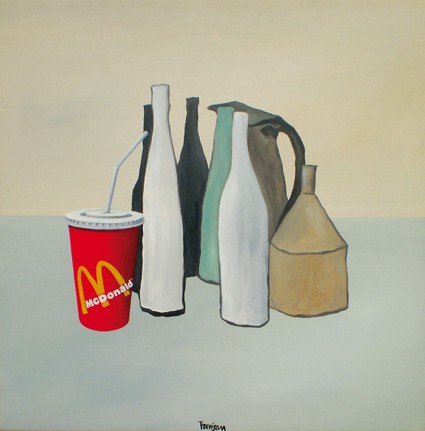
"STILL LIFE WITH Mc DONALD'S" oil on canvas 40x40 cm
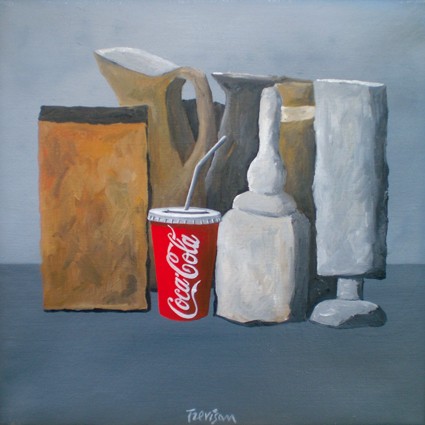
"STILL LIFE WITH COCA COLA" oil on canvas 30x30 cm
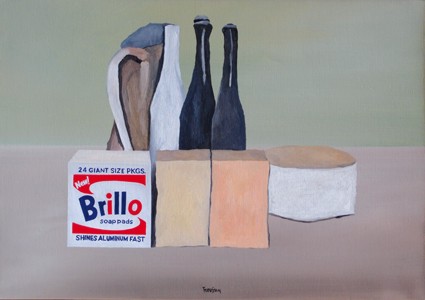
"STILL LIFE WITH BRILLO" oil on canvas 35x50 cm
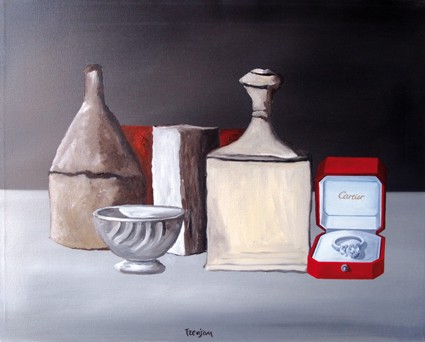
"STILL LIFE WITH CARTIER" oil on canvas 40x50 cm
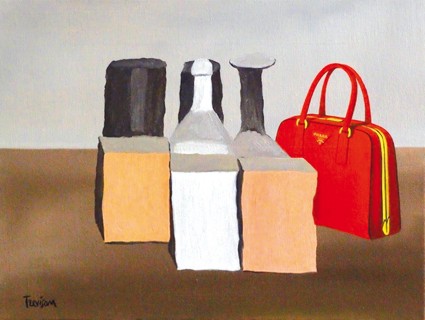
"STILL LIFE WITH PRADA" oil on canvas 30x40 cm
TREVISAN ART GALLERY
Open
9
-
12
pm and
15
-
19
pm
Open Saturday and Sunday
Available by appointment
Via Alberto Mario 4/a - 37121 VERONA
(ITALY)
information / informazioni
[email protected]
|