|
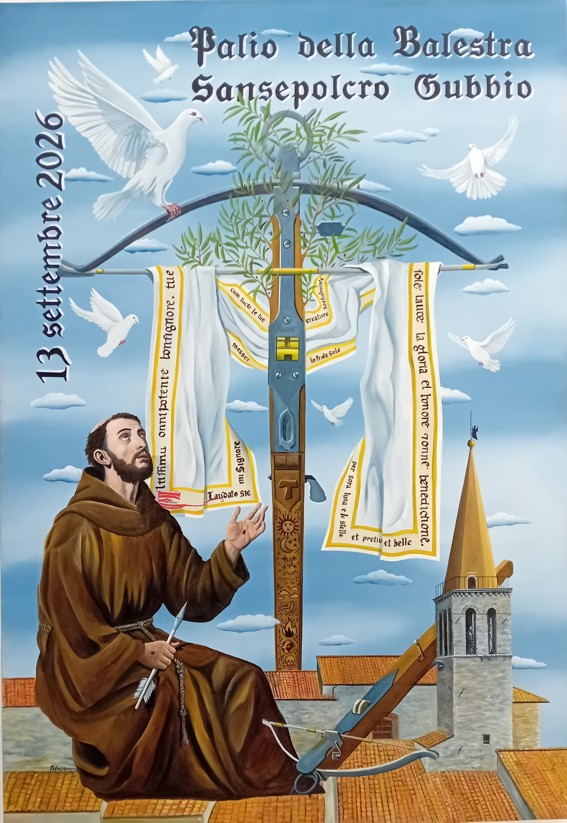
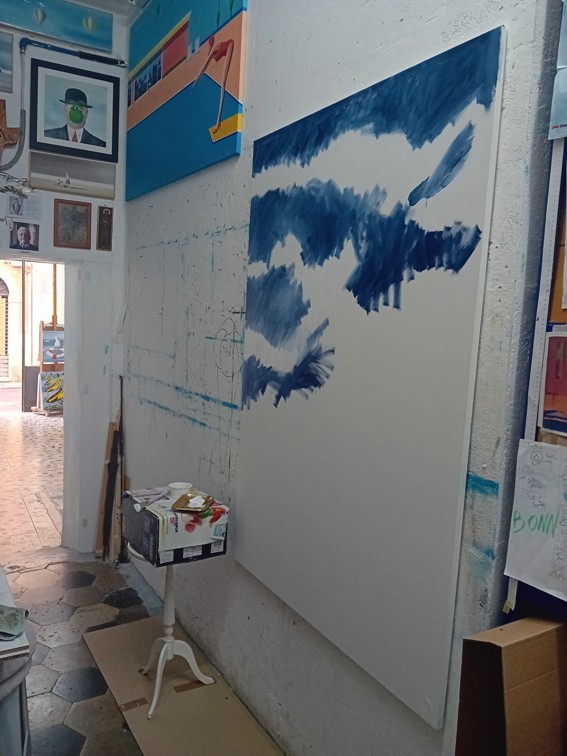
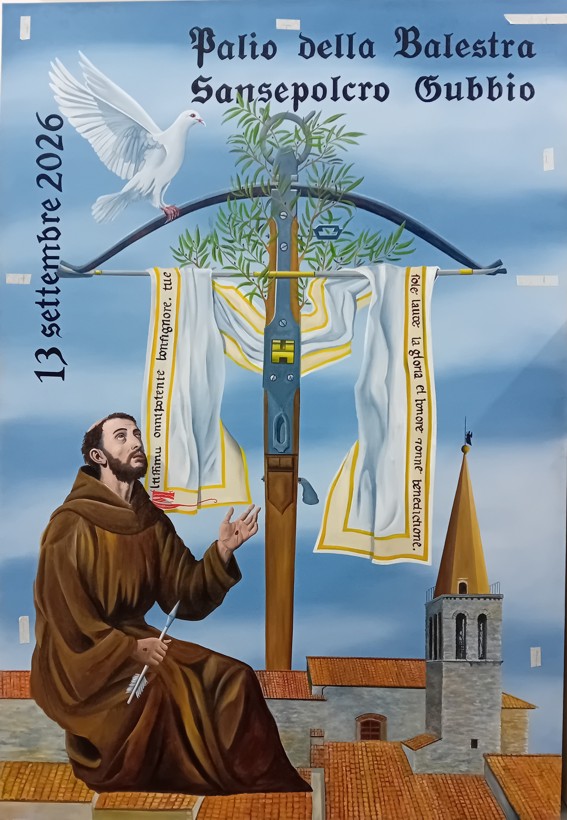
Questo dipinto dell'artista Trevisan, che funge da drappo per il
Palio della Balestra tra Sansepolcro e Gubbio del 13 settembre 2026,
è un'opera dal forte valore simbolico e spirituale, che intreccia la
tradizione storica della sfida con la figura di San Francesco
d’Assisi di cui quest'anno si celebrano gli 800 anni dalla morte.
San Francesco
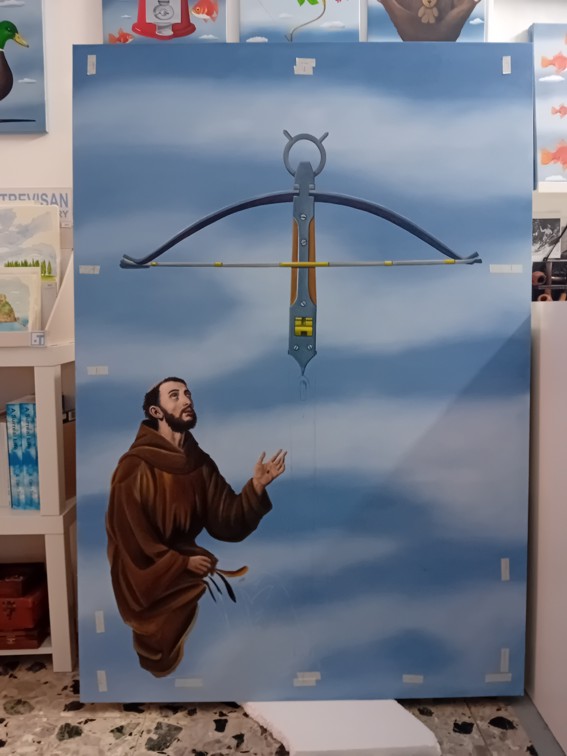
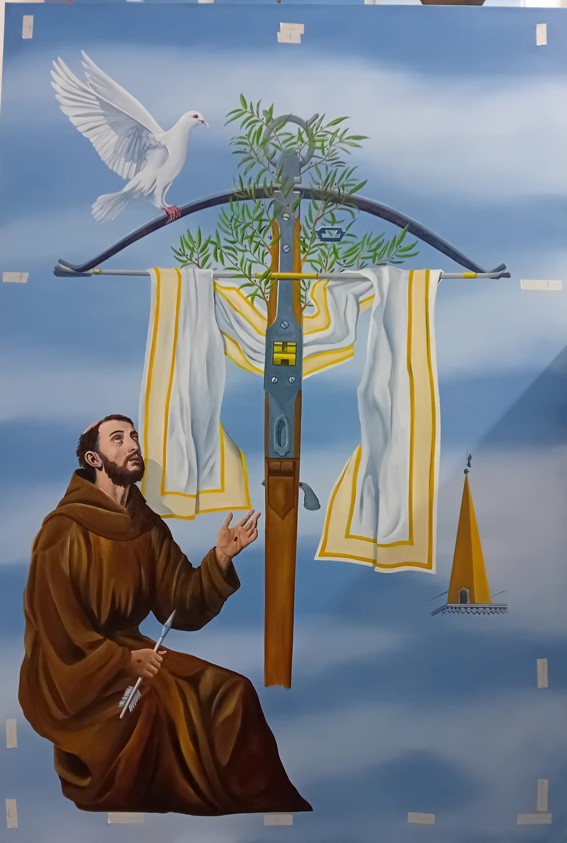
occupa una posizione predominante sul lato sinistro dell'opera. È
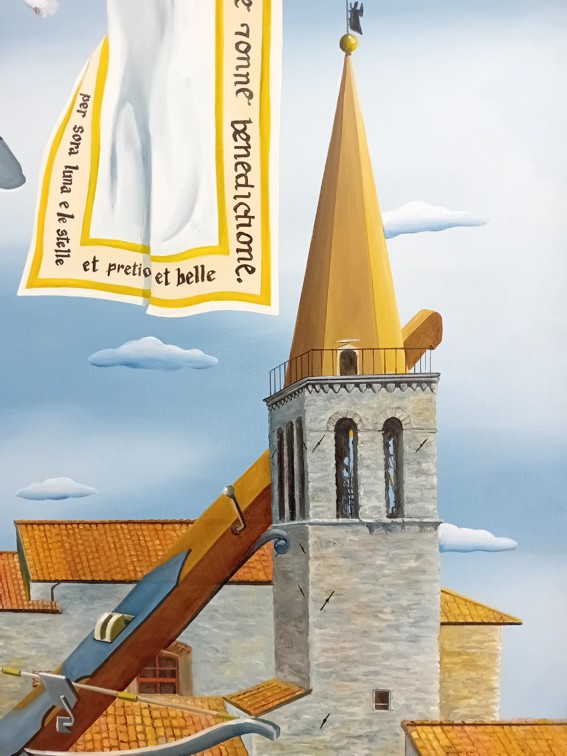
raffigurato seduto sui tetti della chiesa di San Francesco di
Sansepolcro, con lo sguardo rivolto verso l'alto in atteggiamento di
preghiera. Indossa un saio e porta visibili i segni delle stimmate
sulle mani. Nella mano destra regge un dardo bianco, elemento che
crea un legame diretto tra la sua spiritualità e l'evento sportivo
del Palio.
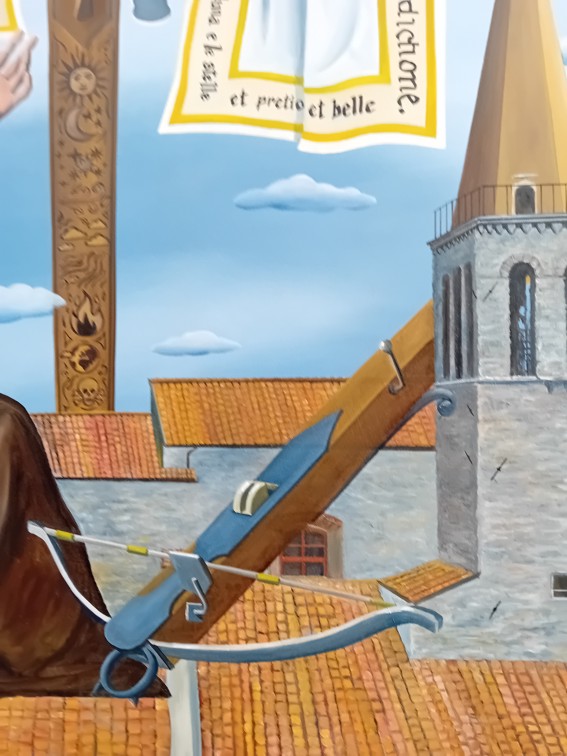
La
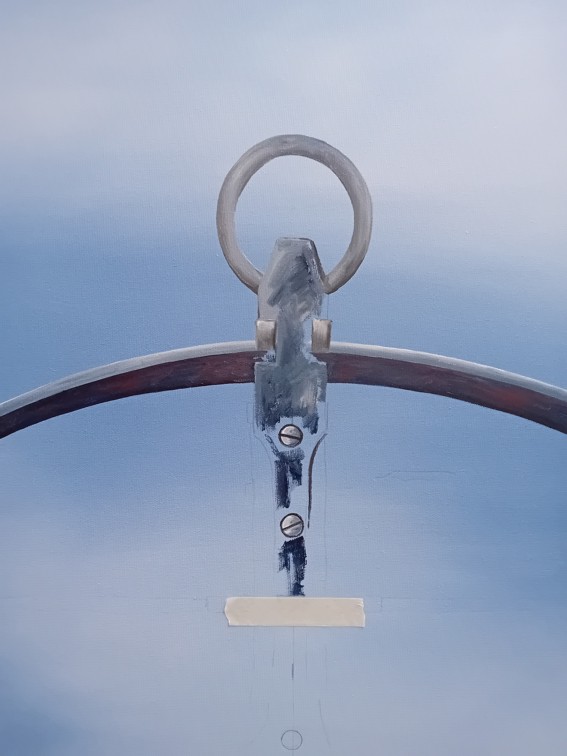
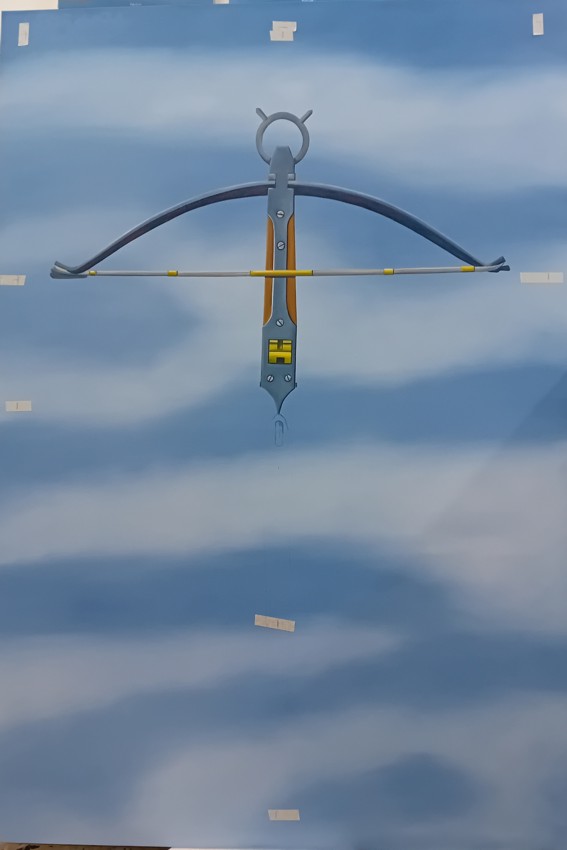
grande balestra,
elemento centrale dell'opera, non è rappresentata come un'arma in
posizione di riposo, ma come un'entità vivente. La balestra non è
più appoggiata o imbracciata, ma è eretta come una grande croce che
collega la terra al cielo. Questa verticalità la trasforma in un
simbolo sacro.
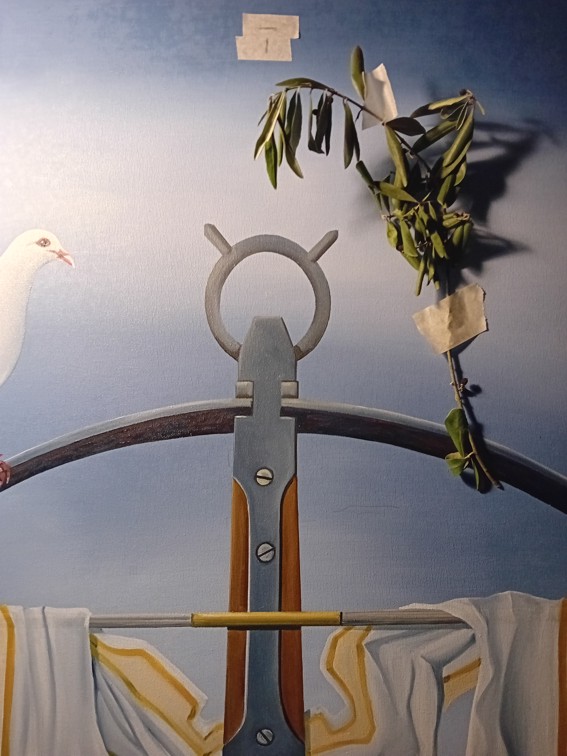
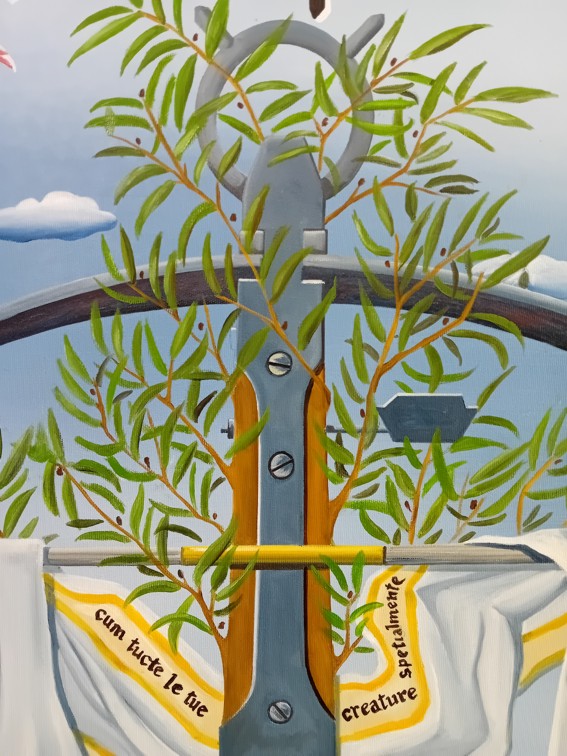
Nella parte alta della
balestra germoglia rigoglioso un ulivo. Questo dettaglio
fonde insieme l'acciaio e il legno con la natura, trasformando
l'arma in un albero della vita che si erge dalla terra verso il
cielo, cosicché la funzione originale di uccidere è sostituita dalla
capacità di generare vita.
Sulla balestra è appeso un
sudario bianco con bordi
dorati, sui quali sono trascritte in calligrafia gotica strofe del
"Cantico delle Creature" di San Francesco, come "Laudato sie, mi
Signore", "Altissimu omnipotente bon Signore", e
riferimenti a "lo frate Sole", "sora luna e le stelle".
Le
colombe bianche
che volano attorno alla balestra sono il sigillo della pace. Simbolo
dello Spirito Santo e della concordia, la loro presenza trasforma il
cielo sopra la balestra in uno spazio di assoluta serenità. Esse
circondano la struttura e si posano su di essa, come a voler
certificare che l'antica funzione bellica è stata definitivamente
soppiantata dall'ideale di fratellanza e competizione leale.
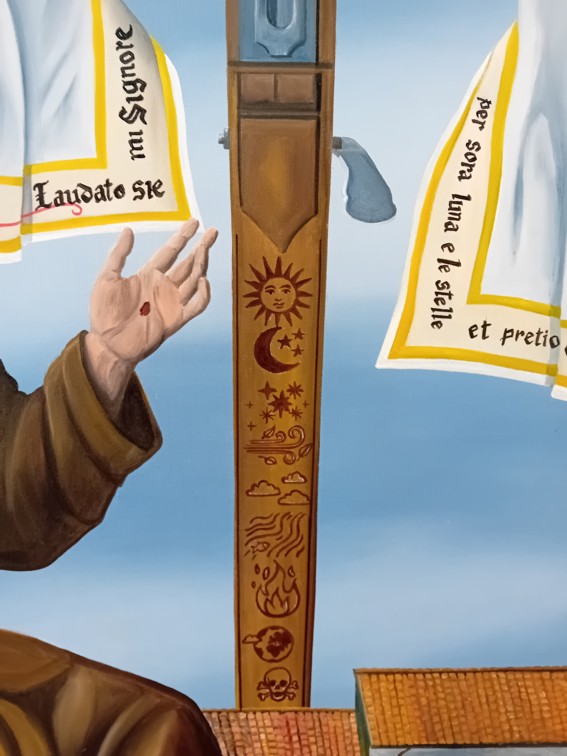
Il fusto della balestra
è decorato con
incisioni
che rappresentano il "Cantico delle Creature". Queste incisioni non
sono solo ornamenti; sono un atto di consacrazione. Il legno che
compone la balestra è stato "risignificato" attraverso le parole di
San Francesco. Le figure del sole, della luna, degli elementi
naturali incidono la materia dell'arma, trasformandola da strumento
di morte in un manifesto del creato e della lode a Dio.
L'artista Trevisan
compie un'operazione di sublimazione, elevando la balestra, oggetto
di competizione sportiva e rievocazione storica, a un livello
spirituale superiore, dove non è più un mezzo per ferire o uccidere
un avversario, ma il punto focale di una comunità che si ritrova nei
valori di pace, natura e spiritualità incarnati da San Francesco. È
un messaggio potente per una gara che, attraverso questa opera,
diviene una vera e propria celebrazione di unità con la vittoria
dello spirito sulla violenza.
ENG
This painting by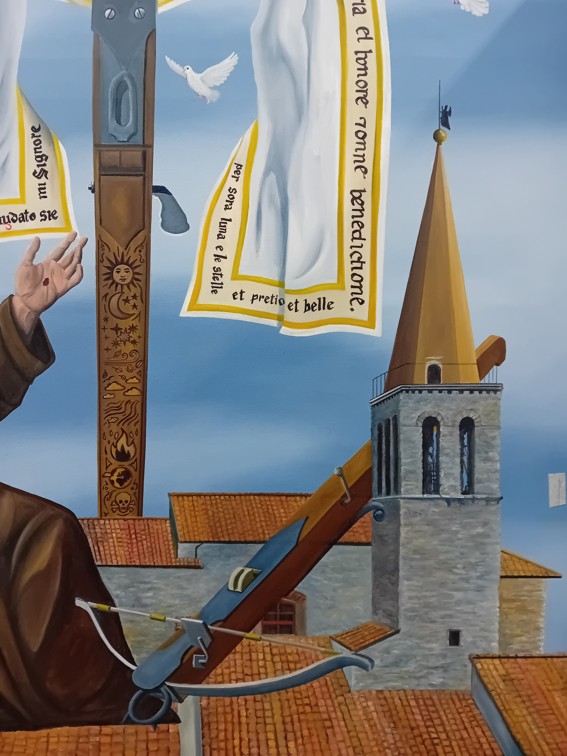 the artist Trevisan, which serves as the banner for the Palio della
Balestra between Sansepolcro and Gubbio on September 13, 2026, is a
work of strong symbolic and spiritual value, intertwining the
historical tradition of the competition with the figure of Saint
Francis of Assisi, whose 800th anniversary of birth is being
celebrated this year.
Saint Francis occupies a prominent position on the left side of the
work.
He is depicted seated on the roofs of the Church of San Francesco in
Sansepolcro, gazing upward in an attitude of prayer.
He wears a habit and bears visible signs of the stigmata on his
hands.
In his right hand, he holds a white arrow, an element that creates a
direct link between his spirituality and the sporting event of the
Palio.
The large crossbow, the central element of the work, is not depicted
as a weapon at rest, but as a living entity.
The crossbow is no longer resting or held in the shoulder, but is
erected like a great cross connecting earth to heaven.
This verticality transforms it into a sacred symbol.
A lush olive tree sprouts from the top of the crossbow.
This detail fuses steel and wood with nature, transforming the
weapon into a tree of life rising from the earth toward the sky,
replacing its original function of killing with the ability to
generate life.
A white shroud with gold edges hangs over the crossbow. It features
verses from
Saint Francis's "Canticle of the Creatures" written in Gothic
calligraphy, such as "Praise be to you, my Lord," "Altissimu
omnipotente bon Signore," and references to "Brother Sun," "Sister
Moon, and the stars." The white doves flying around the crossbow are
the seal of peace.
Symbolizing the Holy Spirit and concord, their presence transforms
the sky above the crossbow into a space of absolute serenity.
They surround the structure and rest on it, as if to certify that
the ancient function of war has been definitively supplanted by the
ideal of brotherhood and fair competition.
The crossbow's shaft is decorated with engravings representing the "Canticle
of the Creatures."
These engravings are not merely ornaments;
they are an act of consecration.
The wood of the crossbow has been "re-signified" through the words
of Saint Francis.
The figures of the sun, the moon, and the natural elements etch the
material of the weapon, transforming it from an instrument of death
into a manifesto of creation and praise to God. The artist Trevisan
performs a sublimation, elevating the crossbow, an object of
sporting competition and historical reenactment, to a higher
spiritual level, where it is no longer a means of wounding or
killing an opponent, but the focal point of a community that finds
itself in the values of peace, nature, and spirituality embodied
by Saint Francis.
It is a powerful message for a race that, through this work, becomes
a true celebration of unity with the victory of the spirit over
violence.
the artist Trevisan, which serves as the banner for the Palio della
Balestra between Sansepolcro and Gubbio on September 13, 2026, is a
work of strong symbolic and spiritual value, intertwining the
historical tradition of the competition with the figure of Saint
Francis of Assisi, whose 800th anniversary of birth is being
celebrated this year.
Saint Francis occupies a prominent position on the left side of the
work.
He is depicted seated on the roofs of the Church of San Francesco in
Sansepolcro, gazing upward in an attitude of prayer.
He wears a habit and bears visible signs of the stigmata on his
hands.
In his right hand, he holds a white arrow, an element that creates a
direct link between his spirituality and the sporting event of the
Palio.
The large crossbow, the central element of the work, is not depicted
as a weapon at rest, but as a living entity.
The crossbow is no longer resting or held in the shoulder, but is
erected like a great cross connecting earth to heaven.
This verticality transforms it into a sacred symbol.
A lush olive tree sprouts from the top of the crossbow.
This detail fuses steel and wood with nature, transforming the
weapon into a tree of life rising from the earth toward the sky,
replacing its original function of killing with the ability to
generate life.
A white shroud with gold edges hangs over the crossbow. It features
verses from
Saint Francis's "Canticle of the Creatures" written in Gothic
calligraphy, such as "Praise be to you, my Lord," "Altissimu
omnipotente bon Signore," and references to "Brother Sun," "Sister
Moon, and the stars." The white doves flying around the crossbow are
the seal of peace.
Symbolizing the Holy Spirit and concord, their presence transforms
the sky above the crossbow into a space of absolute serenity.
They surround the structure and rest on it, as if to certify that
the ancient function of war has been definitively supplanted by the
ideal of brotherhood and fair competition.
The crossbow's shaft is decorated with engravings representing the "Canticle
of the Creatures."
These engravings are not merely ornaments;
they are an act of consecration.
The wood of the crossbow has been "re-signified" through the words
of Saint Francis.
The figures of the sun, the moon, and the natural elements etch the
material of the weapon, transforming it from an instrument of death
into a manifesto of creation and praise to God. The artist Trevisan
performs a sublimation, elevating the crossbow, an object of
sporting competition and historical reenactment, to a higher
spiritual level, where it is no longer a means of wounding or
killing an opponent, but the focal point of a community that finds
itself in the values of peace, nature, and spirituality embodied
by Saint Francis.
It is a powerful message for a race that, through this work, becomes
a true celebration of unity with the victory of the spirit over
violence.
IL PALIO DELLA
BALESTRA
La
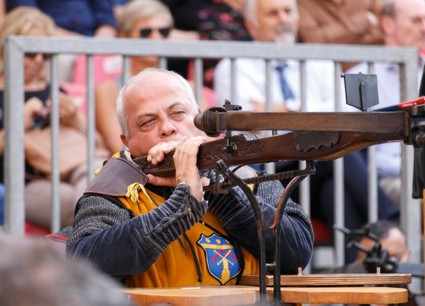
Società Balestrieri di Sansepolcro è un antico
sodalizio che fonda le sue radici nel rinascimento toscano ed ha
saputo perpetuar nel tempo, ininterrottamente dal XV° secolo il
Palio della Balestra, singolar tenzone in cui si
affrontano i balestrieri della città di Sansepolcro contro gli
amici-rivali di sempre della città di Gubbio.
 Senza
interruzione di sorta sono secoli che
Gubbio e
Sansepolcro, con i loro balestrieri,
disputano il
Palio della Balestra
due
volte l'anno, in onore dei propri santi:
Ubaldo, Egidio ed Arcano;
l'ultima domenica di maggio in terra eugubina e la seconda domenica
di settembre a Borgo Santo Sepolcro. Il Palio
è regolato da un antico codice ratificato nel 1619. Senza
interruzione di sorta sono secoli che
Gubbio e
Sansepolcro, con i loro balestrieri,
disputano il
Palio della Balestra
due
volte l'anno, in onore dei propri santi:
Ubaldo, Egidio ed Arcano;
l'ultima domenica di maggio in terra eugubina e la seconda domenica
di settembre a Borgo Santo Sepolcro. Il Palio
è regolato da un antico codice ratificato nel 1619.
La balestra, micidiale arma da postazione usata per
scontri cruenti, è divenuta oggi motivo di incontro, di amicizia e
di fratellanza fra la cultura umbra e quella toscana.
La balestra o "ballista" è composta da un arco di
acciaio posto nella parte estrema di un fusto di legno detto "tiniere"
o "teniere", da una corda fissata all' estremità dell'arco, da un
sistema di caricamento e da uno di puntamento.
Quando il balestriere scocca il tiro, la corda trattenuta dalla
"noce" (aggancio stazionario di caricamento)
libera in maniera folgorante tutta la potenza, dall'arco accumulata
durante il caricamento (la balestra viene caricata
tramite un argano detto "martinetto" o "baldrigo")
e
scaglia il dardo verso un bersaglio, detto "corniolo",
formato da una rotella da cui aggetta un tronco di cono. Il centro è
del diametro di tre centimetri e nel mezzo c'è un chiodo detto
"bulletta" o "pulsone". La distanza regolamentare fra la postazione
di tiro e il bersaglio è di trentasei metri.
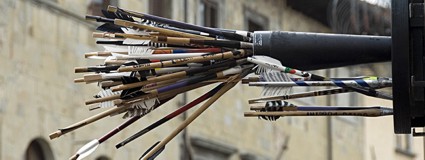
I dardi o frecce scagliati dalla balestra si chiamano anche "verrette",
"verrettoni" o "puntadure". Sono composti da un fusto in legno
tornito, con anteriormente un puntale di ferro e posteriormente da
due penne o "timoni".
I balestrieri sono incitati alla tenzone dal motto:
"si
balestri il Palio con virtù ed onestà e la vittoria arrida a lo
migliore in campo".
ENG
 The
Sansepolcro Crossbow Society is an ancient association rooted in the
Tuscan Renaissance. Since the 15th century, it has perpetuated the
Palio della Balestra, a unique contest in which the crossbowmen of
Sansepolcro compete against their longtime friends and rivals from
Gubbio.
For centuries, Gubbio and Sansepolcro, with their crossbowmen, have
competed in the Palio della Balestra twice a year, in honor of their
saints: Ubaldo, Egidio, and Arcano;
on the last Sunday of May in Gubbio and on the second Sunday of
September in Borgo Santo Sepolcro.
The Palio is governed by an ancient code ratified in 1619. The
crossbow, a deadly weapon used in bloody battles, has today become a
source of encounter, friendship, and brotherhood between the Umbrian
and Tuscan cultures.
The crossbow, or "ballista," is composed of a steel bow placed at
the end of a wooden shaft called a "tiniere" or "teniere," a string
attached to the end of the bow, a loading system, and a sighting
system. When the crossbowman fires, the string, held by the "nut" (stationary
loading catch), releases the full force of the bow's energy
accumulated during loading (the crossbow is loaded using a winch
called a "martinetto" or "baldrigo") in a dazzling fashion, hurling
the bolt toward a target, called a "corniolo," consisting of a small
wheel with a truncated cone protruding from it.
The center is three centimeters in diameter, and in the center is a
nail called a "bulletta" or "pulsone."
The regulation distance between the shooting post and the target is
thirty-six meters.
The bolts or arrows fired from the crossbow are also called "verrette,"
"verrettoni," or "puntadure."
They consist of a turned wooden shaft, with an iron tip at the front
and two feathers or "rudders" at the back.
The crossbowmen are encouraged to compete by the motto: "Let the
Palio be shot with virtue and honesty, and victory go to the best in
the field." The
Sansepolcro Crossbow Society is an ancient association rooted in the
Tuscan Renaissance. Since the 15th century, it has perpetuated the
Palio della Balestra, a unique contest in which the crossbowmen of
Sansepolcro compete against their longtime friends and rivals from
Gubbio.
For centuries, Gubbio and Sansepolcro, with their crossbowmen, have
competed in the Palio della Balestra twice a year, in honor of their
saints: Ubaldo, Egidio, and Arcano;
on the last Sunday of May in Gubbio and on the second Sunday of
September in Borgo Santo Sepolcro.
The Palio is governed by an ancient code ratified in 1619. The
crossbow, a deadly weapon used in bloody battles, has today become a
source of encounter, friendship, and brotherhood between the Umbrian
and Tuscan cultures.
The crossbow, or "ballista," is composed of a steel bow placed at
the end of a wooden shaft called a "tiniere" or "teniere," a string
attached to the end of the bow, a loading system, and a sighting
system. When the crossbowman fires, the string, held by the "nut" (stationary
loading catch), releases the full force of the bow's energy
accumulated during loading (the crossbow is loaded using a winch
called a "martinetto" or "baldrigo") in a dazzling fashion, hurling
the bolt toward a target, called a "corniolo," consisting of a small
wheel with a truncated cone protruding from it.
The center is three centimeters in diameter, and in the center is a
nail called a "bulletta" or "pulsone."
The regulation distance between the shooting post and the target is
thirty-six meters.
The bolts or arrows fired from the crossbow are also called "verrette,"
"verrettoni," or "puntadure."
They consist of a turned wooden shaft, with an iron tip at the front
and two feathers or "rudders" at the back.
The crossbowmen are encouraged to compete by the motto: "Let the
Palio be shot with virtue and honesty, and victory go to the best in
the field."
|