|
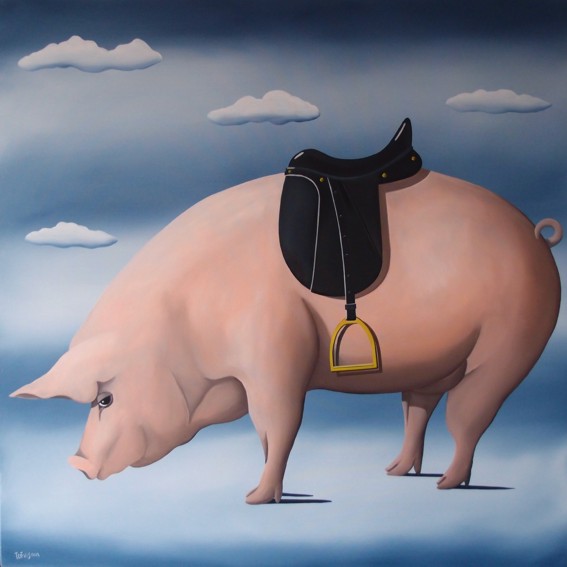
"PINK PIG"
oil on canvas 80 x 80 cm
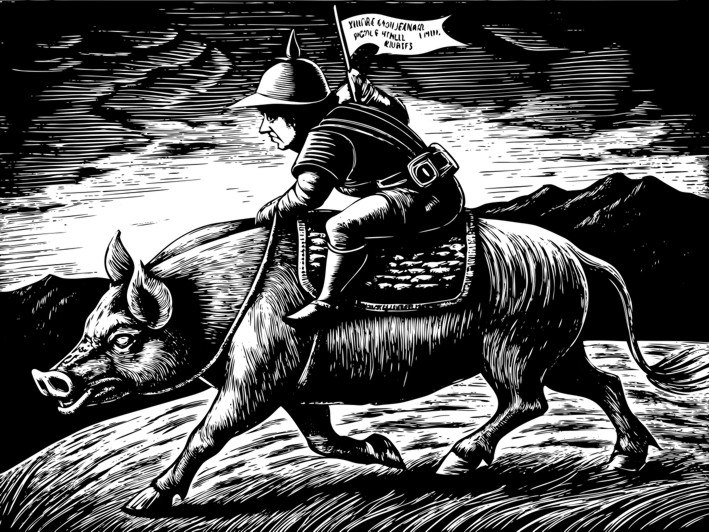
Xylograph
taken from an ancient thirteenth-century book
ENG
PINK PIG The painting presents itself with an almost classical
monumentality, yet the subject is anything but conventional.
The pig, a figure traditionally associated with peasant life, food,
and often with negative connotations such as greed, is here elevated
to the rank of "steed." The black horse saddle, carefully positioned
on the pig's back, is the element that bridges our reality and the one
imagined by the artist.
It is a recognizable object, a symbol of war, speed, and power, but
its placement on such an unexpected animal creates a visual and
conceptual short circuit.
Trevisan forces us to imagine a world in which pigs, with their
strength and tough nature, were trained for war, ridden by medieval
soldiers and used to launch lightning-fast attacks or move with
unexpected speed. In an age of swords, chainmail, and proud steeds,
Carlo Trevisan's work offers us an unexpected and powerful glimpse
into a forgotten art of war: porcine cavalry.
Trevisan suggests that pigs, perhaps because of their tough nature and
ability to overcome difficult terrain, were considered, in certain
parts of northern Italy, a formidable alternative to more expensive
horses.
They may have been slower, but their striking power and the impetus of
their charge made them ideal for breaking through enemy formations or
for sudden assaults. This artistic provocation is not an end in
itself.
Through this reinvention of the past, Trevisan pushes us to question
our certainties.
The artist plays with our expectations, blending the comic with the
serious, the plausible with the absurd.
The pig-steed thus becomes a metaphor for our ability to adapt history
to our needs, to create myths to make sense of the world. The use of
color and light is crucial to the painting's effectiveness.
The figure of the pig, illuminated by an almost theatrical light,
emerges from a dark background, as if to emphasize its centrality and
importance.
The brushstrokes, while precise, convey a certain vitality, a sense of
latent movement that seems to anticipate the furious charge of the
porcine "steed." In conclusion, Carlo Trevisan's work is not just a
painting, but an invitation to profound and ironic reflection.
Through the surreal image of a battle pig, the Cesena-based artist
offers us an alternative interpretation of history, inviting us to
look beyond conventions and recognize that, sometimes, the most
interesting reality is the one we are willing to imagine. Trevisan's
painting is not just an illustration of a lost military custom;
it is a profound reflection on human ingenuity and its ability to
adapt.
The artist elevates the pig, often a symbol of gluttony and
coarseness, to an icon of strength and ferocity, transforming a common
animal into an emblem of power.
His work, though it may seem bizarre today, bears witness to a vision
of the medieval world where survival and conquest depended on
reinventing available resources, even the most unimaginable.
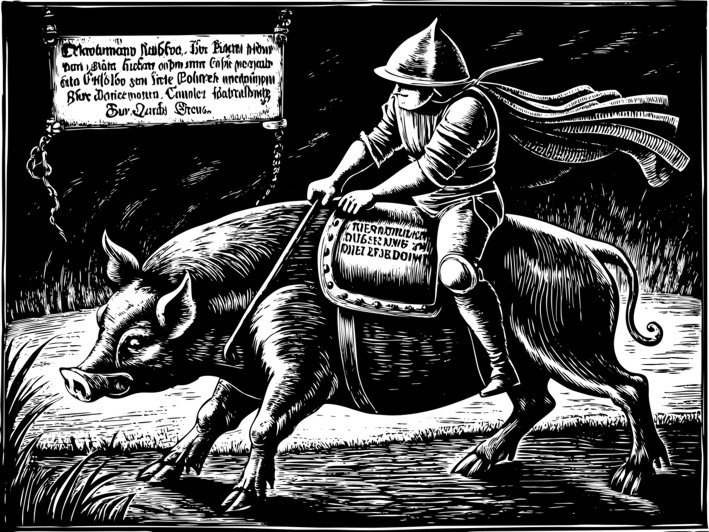
Xylograph
taken from an ancient thirteenth-century book
ITA
Il dipinto si
presenta con una monumentalità quasi classica, eppure il soggetto è
tutt'altro che convenzionale. Il maiale, una figura tradizionalmente
associata alla vita contadina, al cibo e, spesso, a connotazioni
negative come l'ingordigia, viene qui elevato al rango di "destriero".
La sella da
cavallo nera, posizionata con cura sul dorso del maiale, è l'elemento
che fa da ponte tra la nostra realtà e quella ipotizzata dall'artista.
È un oggetto riconoscibile, simbolo di guerra, velocità e potere, ma
la sua collocazione su un animale così inaspettato crea un
cortocircuito visivo e concettuale. Trevisan ci costringe a immaginare
un mondo in cui i maiali, con la loro forza e la loro natura coriacea,
venivano addestrati per la guerra, cavalcati da soldati medievali e
utilizzati per sferrare attacchi fulminei o per spostarsi con una
velocità inaspettata.
In un'epoca di
spade, cotte di maglia e fieri destrieri, l'opera di Carlo Trevisan,
ci offre uno scorcio inaspettato e potente di un'arte bellica
dimenticata: la cavalleria suina. Trevisan suggerisce che i maiali,
forse per la loro natura coriacea e la capacità di superare terreni
impervi, fossero considerati, in certe zone dell'Italia
settentrionale, una formidabile alternativa ai più costosi cavalli.
Erano forse meno veloci, ma la loro forza d'urto e l'impeto della
carica li rendevano ideali per sfondare le formazioni nemiche o per
assalti improvvisi.
Questa
provocazione artistica non è fine a se stessa. Attraverso questa
reinvenzione del passato, Trevisan ci spinge a mettere in discussione
le nostre certezze. L'artista gioca con le nostre aspettative,
mescolando il comico con il serio, il plausibile con l'assurdo. Il
maiale-destriero diventa così una metafora della nostra capacità di
adattare la storia alle nostre esigenze, di creare miti per dare un
senso al mondo.
L'uso del
colore e della luce è fondamentale per l'efficacia del dipinto. La
figura del maiale, illuminata da una luce quasi teatrale, emerge da
uno sfondo scuro, quasi a voler sottolineare la sua centralità e la
sua importanza. Le pennellate, pur essendo precise, lasciano
trasparire una certa vitalità, una sensazione di movimento latente che
sembra voler anticipare la carica furiosa del "destriero" suino.
In
conclusione, l'opera di Carlo Trevisan non è solo un quadro, ma un
invito a una riflessione profonda e ironica. Attraverso l'immagine
surreale di un maiale da battaglia, l'artista di Cesena ci offre una
chiave di lettura alternativa della storia, ci invita a guardare oltre
le convenzioni e a riconoscere che, a volte, la realtà più
interessante è quella che siamo disposti a immaginare.
Il dipinto di
Trevisan non è solo un'illustrazione di un'usanza militare perduta; è
una profonda riflessione sull'ingegno umano e sulla sua capacità di
adattarsi. L'artista eleva il maiale, spesso simbolo di gola e
grossolanità, a icona di forza e ferocia, trasformando un animale
comune in un emblema di potere. La sua opera, sebbene oggi possa
apparire bizzarra, testimonia una visione del mondo medievale dove la
sopravvivenza e la conquista passavano attraverso la reinvenzione
delle risorse a disposizione, anche le più impensabili.
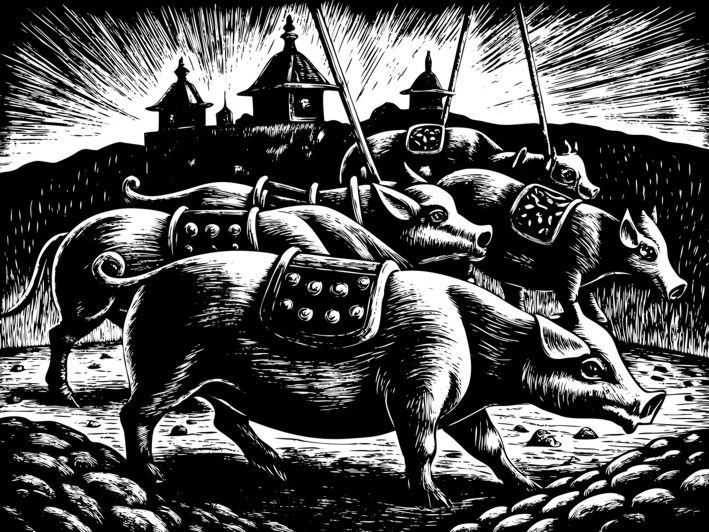
Xylograph
taken from an ancient thirteenth-century book
information / informazioni
[email protected]
|