|
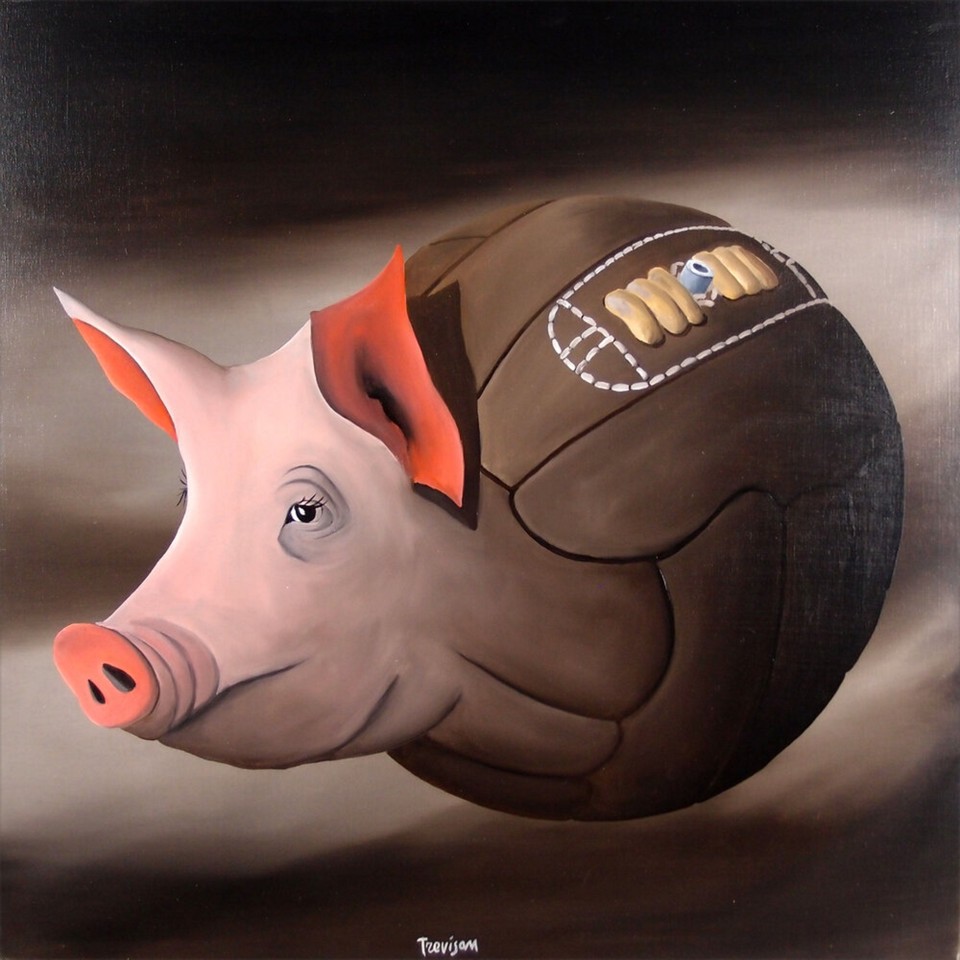
"PIGBALL"
oil on canvas 50 x 50 cm
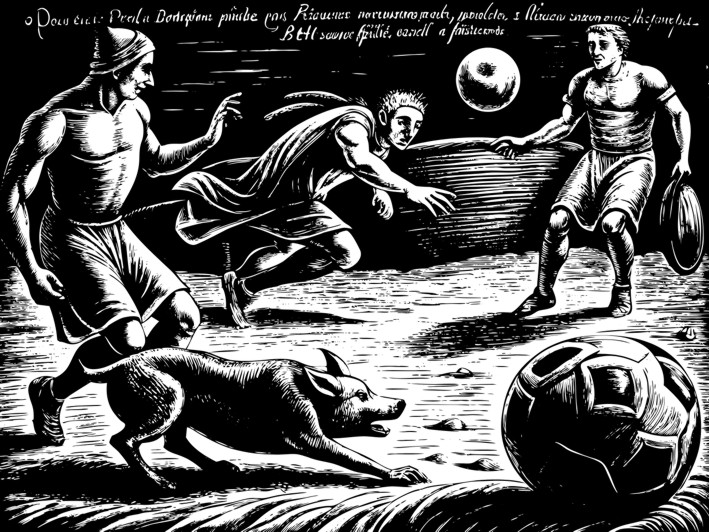
Xylograph
taken from an ancient thirteenth-century book
ENG
In the labyrinth of contemporary surrealist art, Carlo Trevisan's work
emerges with a dreamlike and disturbing force.
His painting, depicting a vintage leather soccer ball with a pig's
head, is not just a canvas, but a window onto a parallel reality,
where history and myth merge into a single, bizarre vision.
At first glance, the work appears to be a trompe-l'oeil, a meticulous
reproduction of a common object, a soccer ball from times gone by.
The precise stitching, the patina of time, the worn texture of the
leather tell a story of games played, of raised dust and sweat.
But it is in the back that the painting reveals its surreal soul: the
head of a pig, with its lively eyes, prominent nose, and pointed ears,
merges with the leather of the ball in a metamorphosis that is both
grotesque and sublime. This juxtaposition is not accidental, but the
result of profound symbolic research.
The pig's head, an animal that has always evoked the earth, instinct,
and carnality, clashes with the ball, a symbol of the game, rules, and
sportsmanship.
But Trevisan goes further, suggesting an even deeper connection with
the tradition of the Calcio Storico Fiorentino. According to the
legends that the artist seems to have wanted to portray, it is said
that, in a distant and savage era, the Calcio Storico Fiorentino
matches were not played with a simple ball, but with these "leather
balls" resembling pigs.
It is said that the challenge was not only to score a "caccia," but
also to tame the intrinsic nature of that living ball, with its
unexpected unpredictability.
The players had to not only kick, but also fight against the instinct
of an animal that, though lifeless, seemed to retain its essence.
Trevisan's work thus becomes a bridge between history and the
unconscious, between memory and dream.
It forces us to reflect on the nature of the game, its brutality and
its beauty.
It's a metaphor for football itself, which is ultimately a battle for
possession, an eternal struggle between the rationality of the game
and the instinctive fury of the players.
Trevisan's "leather ball" isn't just an object, but a character, a
ghost from the past that continues to tell stories of glory and
madness, a disturbing and wonderful anomaly that makes us question
everything we thought we knew about the beautiful game.
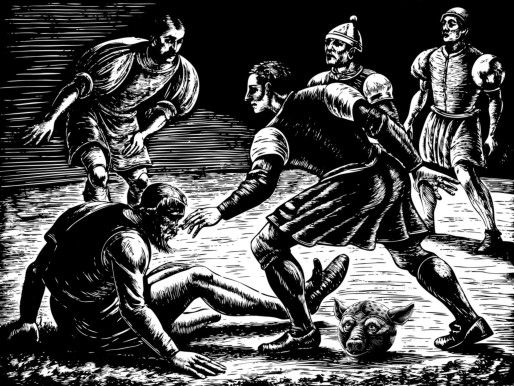
Xylograph
taken from an ancient thirteenth-century book
ITA
Nel labirinto
dell'arte surrealista contemporanea, l'opera di Carlo Trevisan emerge con una forza onirica e disturbante. Il suo
dipinto, che raffigura un pallone di cuoio vintage con una testa di
maiale, non è solo una tela, ma una finestra aperta su una realtà
parallela, dove la storia e il mito si fondono in un'unica, bizzarra
visione.
A un primo sguardo, l'opera si
presenta come un trompe-l'œil, una minuziosa riproduzione di un
oggetto comune, un pallone da calcio d'altri tempi. Le cuciture
precise, la patina del tempo, la texture vissuta del cuoio raccontano
una storia di partite giocate, di polvere sollevata e di sudore. Ma è
nella parte retrostante che il dipinto rivela la sua anima surreale:
la testa di un maiale, con i suoi occhi vispi, il naso prominente e le
orecchie appuntite, si fonde con la pelle del pallone in una
metamorfosi che ha del grottesco e del sublime.
Questo accostamento non è casuale,
ma il risultato di una profonda ricerca simbolica. La testa di maiale,
animale che da sempre evoca la terra, l'istinto e la carnalità, si
scontra con il pallone, simbolo di gioco, di regole e di sportività.
Ma Trevisan va oltre, suggerendo una connessione ancora più profonda
con la tradizione del Calcio Storico Fiorentino.
Secondo le leggende che l'artista
sembra aver voluto dipingere, si narra che, in un'epoca lontana e
selvaggia, le partite del Calcio Storico Fiorentino non fossero giocate con un
semplice pallone, ma con questi "palloni di cuoio" dalle sembianze
suine. Si racconta che la sfida fosse non solo quella di segnare una
"caccia", ma anche di domare la natura intrinseca di quel pallone
vivente, con la sua inaspettata imprevedibilità. I giocatori non
dovevano solo calciare, ma anche lottare contro l'istinto di un
animale che, pur se privo di vita, sembrava conservarne l'essenza.
L'opera di Trevisan diventa così
un ponte tra la storia e l'inconscio, tra il ricordo e il sogno. Ci
costringe a riflettere sulla natura del gioco, sulla sua brutalità e
sulla sua bellezza. È una metafora del calcio stesso, che in fondo è
una lotta per il possesso, un'eterna battaglia tra la razionalità
del gioco e la furia istintiva dei giocatori. Il "pallone di cuoio"
di Trevisan non è solo un oggetto, ma un personaggio, un fantasma
del passato che continua a raccontare storie di gloria e di follia,
un'inquietante e meravigliosa anomalia che ci fa dubitare di tutto
ciò che pensavamo di sapere sul gioco più bello del mondo.
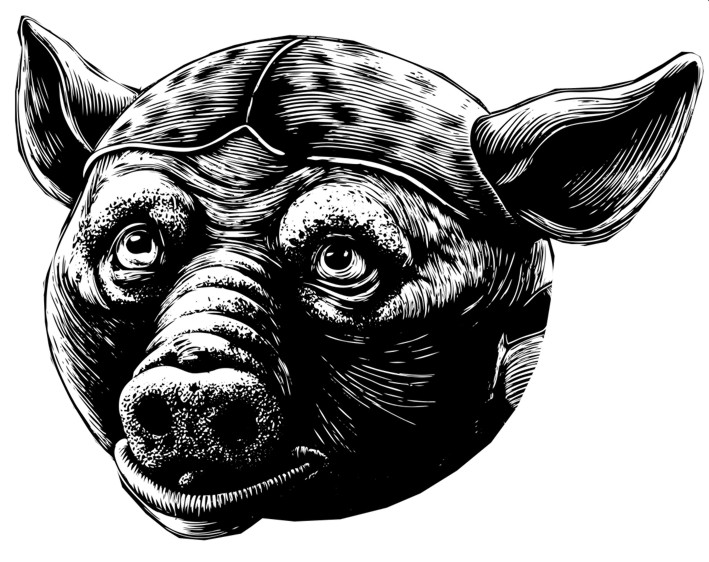
Xylograph
taken from an ancient thirteenth-century book
information / informazioni
[email protected]
|