|
Critical
Analysis of "The Golden Bottom":
An
Investigation of Relationships and Hidden Value
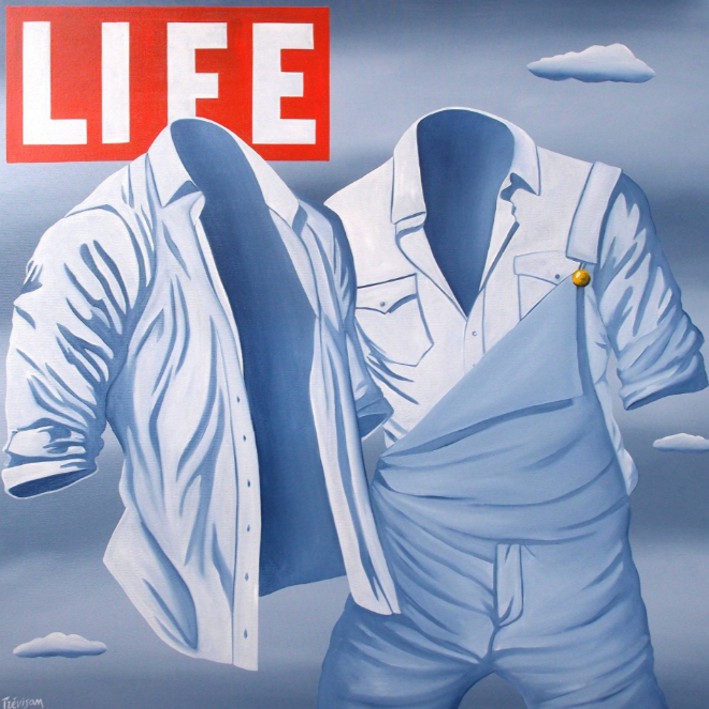
Il dipinto "The Golden
Bottom", olio su tela 80x80 cm, dell'artista internazionale Carlo
Trevisan (nato a Cesena), si inserisce nel suo corpus di opere che
esplorano le dinamiche umane attraverso un linguaggio che fonde
realismo, Pop Art e simbolismo. Come "Together", anche quest'opera
affronta il tema del rapporto tra uomini omosessuali, ma con una
prospettiva differente e una carica simbolica ancor più sottile e
complessa. Rivolto a un pubblico specializzato (storici dell'arte,
curatori, accademici), questo testo critico si propone di
decodificare le molteplici stratificazioni di significato di
un'opera che, pur nella sua apparente sobrietà, si rivela
un'indagine profonda sul valore, sull'identità e sulla relazione.
La Composizione e la
Decontestualizzazione del Soggetto: Un Nuovo Dialogo
Come nel dipinto precedente,
Trevisan presenta due figure maschili senza volto, prive di
identità specifiche, ma questa volta la loro interazione è meno
esplicita. Le due figure sono affiancate, l'una vestita con una
camicia aperta, l'altra con una camicia abbottonata e una
salopette. L'assenza delle teste continua a essere un elemento
chiave, una scelta deliberata che obbliga lo spettatore a
concentrarsi sul linguaggio del corpo, sulla vestizione e sugli
elementi simbolici introdotti dall'artista. L'attenzione non è
sull'individuo, ma sul rapporto che si instaura tra i due. La
distanza fisica tra le due figure è minima, ma la loro interazione
non è un abbraccio, bensì una vicinanza che suggerisce complicità,
condivisione e un'intimità non verbale.
La composizione si sviluppa
su un fondo di cielo nuvoloso, con un blu-grigio monocromatico che
evoca un senso di introspezione e di sospensione temporale. Le
nuvole, dipinte con un realismo stilizzato, fungono da fondale
scenografico per un dramma interiore che si svolge attraverso i
vestiti e i simboli.
Il Riferimento
Iconografico: Una Conversazione con la Cultura di Massa
Anche in questo dipinto,
Trevisan non rinuncia al suo marchio di fabbrica: il logo "LIFE"
in rosso e bianco, che si staglia in alto a sinistra. Come in "Together",
la citazione della celebre rivista non è un mero decoro, ma un
elemento critico. La parola "LIFE" (vita) diventa un'affermazione
programmatica, un manifesto che sancisce l'inclusione di queste
relazioni umane nella grande narrazione del vivere. Il
posizionamento del logo, così come le nuvole che incorniciano la
scena, conferisce all'opera un'aura di monumentalità e di
universalità, come se la scena ritratta fosse un'immagine iconica
della vita stessa, meritevole di apparire sulla copertina di una
delle più importanti riviste del XX secolo. La scelta di questo
riferimento storico e culturale posiziona l'opera in un dialogo
continuo con la storia della rappresentazione e la sua capacità di
includere o escludere determinate narrazioni.
Critical Analysis of
"The Golden Bottom" by Carlo Trevisan: An Investigation of
Relationships and Hidden Value
The painting "The Golden Bottom," oil on canvas, 80x80 cm, by
internationally renowned artist Carlo Trevisan (born in Cesena),
is part of his body of work exploring human dynamics through a
language that blends realism, Pop Art, and symbolism.
Like
"Together," this work also addresses the theme of relationships
between homosexual men, but with a different perspective and an
even more subtle and complex symbolic charge.
Aimed
at a specialized audience (art historians, curators, academics),
this critical text aims to decode the multiple layers of meaning
of a work that, despite its apparent simplicity, reveals itself as
a profound investigation of value, identity, and relationships.
Composition and the
Decontextualization of the Subject: A New Dialogue
As in the previous painting, Trevisan presents two faceless male
figures, devoid of specific identities, but this time their
interaction is less explicit.
The two
figures are placed side by side, one wearing an open shirt, the
other a buttoned shirt and overalls.
The
absence of heads continues to be a key element, a deliberate
choice that forces the viewer to focus on body language, clothing,
and the symbolic elements introduced by the artist.
The focus
is not on the individual, but on the relationship that develops
between the two.
The
physical distance between the two figures is minimal, but their
interaction is not an embrace, but rather a closeness that
suggests complicity, sharing, and a nonverbal intimacy. The
composition unfolds against a cloudy sky, with a monochromatic
blue-gray that evokes a sense of introspection and temporal
suspension.
The
clouds, painted with stylized realism, serve as a scenic backdrop
for an internal drama unfolding through clothing and symbols.
The
Iconographic Reference: A Conversation with Mass Culture
In this painting, too, Trevisan does not abandon his trademark:
the red and white "LIFE" logo, which stands out in the upper left
corner.
As in "Together,"
the quote from the famous magazine is not merely decorative, but a
critical element.
The word
"LIFE" becomes a programmatic statement, a manifesto that
establishes the inclusion of these human relationships in the
grand narrative of life.
The
positioning of the logo, as well as the clouds framing the scene,
lends the work an aura of monumentality and universality, as if
the scene depicted were an iconic image of life itself, worthy of
appearing on the cover of one of the most important magazines of
the 20th century.
The
choice of this historical and cultural reference places the work
in an ongoing dialogue with the history of representation and its
ability to include or exclude certain narratives.
Il Simbolismo del "Golden
Bottom": Il Valore Nascosto
Il titolo dell'opera, "The
Golden Bottom" (Il bottone d'oro), introduce l'elemento simbolico
più potente e enigmatico del dipinto. Un piccolo bottone dorato,
posto sul petto della figura con la salopette, si distingue
nettamente dalla monocromia del resto della scena. Questo bottone
non è un dettaglio casuale; è il punto focale dell'opera,
l'elemento che rompe l'uniformità cromatica e cattura l'attenzione
dello spettatore.
Il "bottone d'oro" può
essere interpretato in molteplici modi. A un livello letterale,
potrebbe essere un elemento distintivo di un capo d'abbigliamento.
A un livello simbolico, tuttavia, il suo significato si
stratifica. L'oro, in tutte le culture, è simbolo di valore, di
preziosità, di qualcosa di raro e di inestimabile. In questo
contesto, il "bottone d'oro" può rappresentare il "valore" della
persona o, più precisamente, il valore intrinseco e la dignità del
rapporto che si sta instaurando. La sua posizione, sul petto,
allude al cuore, al centro delle emozioni e della vita.
Il titolo, "The Golden
Bottom", gioca anche sulla parola "bottom" (fondo/sedere), che nel
linguaggio gergale della comunità gay ha un significato sessuale.
Trevisan, con eleganza e ironia, trasforma un termine
potenzialmente volgare in un'affermazione poetica e preziosa. Il "bottom"
non è più solo una parte del corpo, ma un simbolo di valore e di
dignità, un riconoscimento che l'intimità fisica e l'affettività
non sono slegate, ma parte di un unicum prezioso. L'artista, con
questa scelta, eleva il tema, superando il tabù e trasformando un
concetto triviale in un simbolo di nobiltà e di amore.
Tecnica e Stile: La
Pittura come Narrazione Sottile
La maestria di Trevisan
nell'uso dell'olio su tela è evidente anche in quest'opera. La
resa delle pieghe delle camicie e della salopette è meticolosa,
quasi scultorea. L'artista utilizza le sfumature di grigio e blu
per creare un senso di volume e di realismo che contrasta con la
natura concettuale dell'opera. Questa tensione tra realismo e
astrazione è una delle caratteristiche distintive dello stile di
Trevisan.
Le due figure, pur essendo
prive di volti, sono cariche di personalità. La figura a sinistra,
con la camicia aperta, evoca un senso di apertura e di
vulnerabilità. La figura a destra, con la salopette, suggerisce
un'immagine di lavoro, di concretezza, di radicamento.
L'abbinamento di questi due abiti, e quindi di questi due "mondi",
crea una narrazione non verbale che invita lo spettatore a
immaginare la storia di queste due persone e il loro legame.
Conclusioni: Un'Opera di
Profondità Concettuale
In conclusione, "The Golden
Bottom" di Carlo Trevisan è un'opera di grande spessore critico,
che affronta il tema del rapporto omosessuale con una profondità e
una delicatezza rare. L'artista, attraverso l'uso sapiente di
simboli come il bottone d'oro e il logo "LIFE", e attraverso una
pittura raffinata che fonde realismo e concettualismo, invita lo
spettatore a una riflessione stratificata. Il dipinto non è una
semplice rappresentazione, ma una meditazione sul valore
intrinseco delle relazioni umane, sulla dignità dell'amore in
tutte le sue forme e sulla necessità di includere tutte le
narrazioni nella grande storia della vita. La trasformazione di un
termine gergale in un simbolo di preziosità e il posizionamento di
un'intimità silenziosa in un contesto di cultura di massa, rendono
"The Golden Bottom" un'opera di grande rilevanza nel dibattito
artistico contemporaneo. È un dipinto che dimostra come l'arte,
con sensibilità e intelligenza, possa superare gli stereotipi e
aprire nuovi orizzonti di significato e di comprensione.
The
Symbolism of the "Golden Bottom": The Hidden Value
The title of the work, "The Golden Bottom," introduces the
painting's most powerful and enigmatic symbolic element.
A small
golden button, placed on the chest of the figure in overalls,
stands out clearly from the monochrome rest of the scene.
This
button is not a random detail;
it
is the focal point of the work, the element that breaks the
chromatic uniformity and captures the viewer's attention. The "golden
button" can be interpreted in multiple ways.
On a
literal level, it could be a distinctive element of an item of
clothing.
On a
symbolic level, however, its meaning is multilayered.
Gold,
in all cultures, is a symbol of value, preciousness, something
rare and invaluable.
In this
context, the "golden button" can represent the "worth" of the
person or, more precisely, the intrinsic value and dignity of the
relationship being established.
Its
position, on the chest, alludes to the heart, the center of
emotions and life. The title, "The Golden Bottom," also plays on
the word "bottom," which in gay slang has a sexual connotation.
Trevisan,
with elegance and irony, transforms a potentially vulgar term into
a poetic and precious statement.
The "bottom"
is no longer just a part of the body, but a symbol of value and
dignity, an acknowledgement that physical intimacy and affection
are not separate, but part of a precious whole.
With
this choice, the artist elevates the theme, transcending the taboo
and transforming a trivial concept into a symbol of nobility and
love.
Technique and Style:
Painting as Subtle Narration
Trevisan's mastery of oil on canvas
is also evident in this work.
The
rendering of the folds of the shirts and overalls is meticulous,
almost sculptural.
The
artist uses shades of gray and blue to create a sense of volume
and realism that contrasts with the conceptual nature of the work.
This
tension between realism and abstraction is one of the defining
characteristics of Trevisan's style. The two figures, despite
being faceless, are full of personality.
The
figure on the left, with an open shirt, evokes a sense of openness
and vulnerability.
The
figure on the right, wearing overalls, suggests an image of work,
concreteness, and rootedness.
The
pairing of these two outfits, and therefore of these two "worlds,"
creates a nonverbal narrative that invites the viewer to imagine
the story of these two people and their bond.
Conclusions: A Work of
Conceptual Depth
In conclusion, Carlo Trevisan's "The Golden Bottom" is a work of
great critical depth, which addresses the theme of homosexual
relationships with rare depth and delicacy.
Through
the skillful use of symbols such as the golden button and the
"LIFE" logo, and through a refined painting style that blends
realism and conceptualism, the artist invites the viewer into a
multilayered reflection.
The
painting is not a simple representation, but a meditation on the
intrinsic value of human relationships, the dignity of love in all
its forms, and the need to include all narratives in the grand
story of life.
The
transformation of a slang term into a symbol of preciousness and
the positioning of silent intimacy in a context of mass culture
make "The Golden Bottom" a highly relevant work in contemporary
artistic discourse.
It
is a painting that demonstrates how art, with sensitivity and
intelligence, can transcend stereotypes and open new horizons of
meaning and understanding.
|