|
Critical
Analysis of "Together":
Beyond Appearances, a Dialogue on the Representation of Homosexual
Love
Il dipinto "Together", olio
su tela 80x80 cm, dell'artista internazionale Carlo Trevisan (nato
a Cesena), si presenta come un'opera di grande raffinatezza
concettuale e pittorica, che affronta con delicatezza e profondità
il tema complesso e sfaccettato del rapporto tra persone
omosessuali. Rivolto a un pubblico specializzato (storici
dell'arte, curatori, accademici), questo testo critico si propone
di decodificare il linguaggio visivo di Trevisan, analizzando la
sua capacità di superare gli stereotipi e di esplorare la natura
universale dell'affetto, dell'intimità e della connessione umana,
utilizzando un vocabolario che fonde Pop Art, realismo e
simbolismo.
La Composizione e la
Decontestualizzazione del Soggetto
La composizione del dipinto
è immediatamente riconoscibile per la sua apparente semplicità,
che nasconde una stratificazione di significati. Due figure
maschili, senza testa, vestite con camicie bianche, sono ritratte
in un abbraccio o in un incrocio di braccia che suggerisce un
legame intimo. La mancanza delle teste non è un'omissione casuale,
ma una scelta programmatica che sposta il focus dalla singola
identità individuale al concetto di relazione. L'assenza di tratti
somatici specifici rende le figure archetipiche, simboli di
un'umanità che trascende la specificità dell'apparenza.
L'attenzione si concentra sul linguaggio del corpo, sull'intreccio
delle braccia, sulla prossimità fisica, elementi che diventano il
veicolo principale del significato emotivo.
La monocromia dominante, con
sfumature di blu e grigio, conferisce all'opera un'atmosfera di
sospensione e di introspezione. Il cielo nuvoloso sullo sfondo,
che potrebbe evocare una condizione di malinconia o di incertezza,
è controbilanciato da una nuvola rossa in alto a sinistra, un
elemento di rottura e di enfasi visiva che introduce un elemento
di passione o di drammaticità.
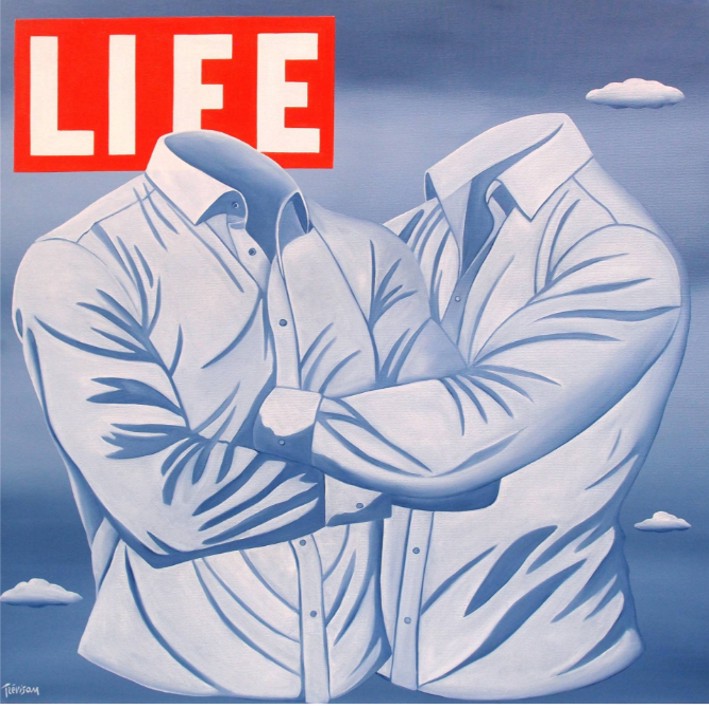
The painting "Together," oil on canvas,
80x80 cm, by the internationally renowned artist Carlo Trevisan (born
in Cesena), presents itself as a work of great conceptual and
pictorial refinement, delicately and profoundly addressing the
complex and multifaceted theme of homosexual relationships.
Aimed
at a specialized audience (art historians, curators, academics),
this critical text aims to decode Trevisan's visual language,
analyzing his ability to transcend stereotypes and explore the
universal nature of affection, intimacy, and human connection,
using a vocabulary that blends Pop Art, realism, and symbolism.
Composition and the Decontextualization of
the Subject
The composition of the painting is
immediately recognizable for its apparent simplicity, which
conceals a layering of meaning.
Two
headless male figures, dressed in white shirts, are portrayed in
an embrace or with arms crossed, suggesting an intimate bond.
The
lack of heads is not a random omission, but a deliberate choice
that shifts the focus from individual identity to the concept of
relationship.
The
absence of specific physical features makes the figures archetypal,
symbols of a humanity that transcends the specificity of
appearance.
Attention is focused on body language, the intertwining of arms,
and physical proximity, elements that become the primary vehicle
of emotional meaning. The dominant monochrome, with shades of blue
and gray, gives the work an atmosphere of suspension and
introspection.
The
cloudy sky in the background, which could evoke a sense of
melancholy or uncertainty, is counterbalanced by a red cloud in
the upper left, a visually arresting element that introduces a
sense of passion or drama.
Il Riferimento
Iconografico e la Critica Sociale
Il titolo "Together" e il
contesto visivo in cui le figure sono immerse, richiamano in modo
evidente le celebri copertine della rivista "LIFE", un'istituzione
del fotogiornalismo e della cultura popolare americana del XX
secolo. Questa scelta non è puramente estetica, ma una
dichiarazione critica. La rivista "LIFE" era, per la sua epoca, un
faro di narrazione visiva, che raccontava la storia del mondo
attraverso le immagini. Trevisan, inserendo la sua scena in questo
contesto, pone un quesito fondamentale: quale posto aveva e ha,
nella narrazione "ufficiale" e popolare, il rapporto omosessuale?
La sua opera suggerisce che questo amore, questa intimità, è parte
integrante della "vita" stessa, meritevole di essere rappresentata
e celebrata con la stessa dignità. Il nome "LIFE" diventa, in
questo senso, un'affermazione, un'inclusione.
Il lettering della scritta
"LIFE", un rettangolo rosso con la scritta in bianco, è un
elemento stilistico che Trevisan ha già esplorato in altre opere,
un marchio di fabbrica che unisce il linguaggio del Pop Art, con
la sua fascinazione per i media di massa e la pubblicità, a una
riflessione più profonda sul significato. Qui, la scritta non è un
semplice logo, ma un'affermazione del diritto all'esistenza e alla
visibilità.
La Pittura come Veicolo
di Emozione e la Raffinatezza Tecnica
Dal punto di vista tecnico,
l'opera dimostra la maestria di Trevisan nell'uso dell'olio. Le
pieghe delle camicie sono rese con una precisione quasi
fotografica, ma non in modo asettico. Le sfumature di grigio e
blu, che suggeriscono ombre e rilievi, creano un senso di volume e
di tridimensionalità. La pittura diventa un mezzo per dare vita
alla stoffa, per renderla tangibile e per farne un veicolo di
espressione. Il tocco dell'artista è delicato ma fermo, capace di
descrivere la materialità dei tessuti e, al contempo, di
trasmettere l'intangibilità dei sentimenti.
L'assenza delle teste, pur
essendo una scelta concettuale, ha anche una valenza pittorica.
Libera l'artista dalla necessità di ritrarre le espressioni
facciali, permettendogli di concentrarsi sul linguaggio universale
del corpo. L'abbraccio, l'incrocio delle braccia, l'intimità delle
figure, tutto ciò viene trasmesso senza la mediazione dello
sguardo o del sorriso. Questa scelta rende l'opera più potente
e universale. L'emozione non è descritta, ma suggerita, lasciando
allo spettatore la libertà di proiettare i propri sentimenti e le
proprie esperienze sulla tela.
Iconographic Reference and Social Critique
The title "Together" and the visual
context surrounding the figures clearly recall the famous covers
of LIFE magazine, an institution of 20th-century American
photojournalism and popular culture.
This
choice is not purely aesthetic, but a critical statement.
LIFE
magazine was, for its time, a beacon of visual storytelling,
telling the story of the world through images.
Trevisan, placing his scene in this context, raises a fundamental
question: what place did and does homosexual relationships have in
the "official" and popular narrative?
His
work suggests that this love, this intimacy, is an integral part
of "life" itself, deserving of being represented and celebrated
with the same dignity.
The
name "LIFE" becomes, in this sense, an affirmation, a symbol of
inclusion. The lettering of the word "LIFE," a red rectangle with
white text, is a stylistic element Trevisan has explored in other
works, a trademark that combines the language of Pop Art, with its
fascination with mass media and advertising, with a deeper
reflection on meaning.
Here,
the writing is not a simple logo, but an affirmation of the right
to existence and visibility.
Painting as a Vehicle of Emotion and
Technical Refinement
From a technical standpoint,
the work demonstrates Trevisan's mastery of oil paint.
The folds of the shirts are
rendered with almost photographic precision, yet not in a sterile
manner.
The shades of gray and blue,
suggesting shadows and reliefs, create a sense of volume and
three-dimensionality.
Painting becomes a means of
bringing the fabric to life, making it tangible and transforming
it into a vehicle of expression.
The artist's touch is
delicate yet firm, capable of describing the materiality of the
fabrics while simultaneously conveying the intangibility of
feelings. The absence of heads, while a conceptual choice, also
has pictorial significance.
It frees the artist from the
need to portray facial expressions, allowing him to focus on the
universal language of the body.
The embrace, the crossing of
arms, the intimacy of the figures—all this is conveyed without the
mediation of a gaze or a smile.
This choice makes the work
more powerful and universal.
The emotion is not
described, but suggested, leaving the viewer free to project their
own feelings and experiences onto the canvas.
Il Tema
Omosessuale e la Lotta per la Visibilità
L'approccio di
Trevisan al tema del rapporto gay è, come suggerito nel prompt,
delicato. Non c'è drammaticità, non c'è denuncia esplicita, ma una
rappresentazione serena e dignitoso. A differenza di molti artisti
che hanno affrontato il tema in modo più esplicito o provocatorio,
Trevisan sceglie la strada dell'intimità e dell'universalità.
L'amore tra questi due uomini non è un'eccezione, ma una parte
della vita.
La storia
dell'arte è stata a lungo dominata da rappresentazioni di coppie
eterosessuali, e la rappresentazione dell'amore omosessuale è
stata spesso relegata a contesti marginali o, quando presente,
connotata da un senso di segretezza o di trasgressione. "Together"
si inserisce in questo dibattito, proponendo un'immagine che
normalizza l'affetto omosessuale senza banalizzarlo. L'abbraccio,
l'unione dei corpi, è un gesto che appartiene a tutti,
indipendentemente dall'orientamento sessuale. L'opera di Trevisan,
quindi, non parla solo di amore omosessuale, ma del concetto
stesso di amore, di sostegno reciproco e di unità.
L'Uso del
Simbolismo: La Camicia e la Nuvola Rossa
La camicia bianca,
simbolo di ordine, di lavoro, di formalità, assume qui un
significato più profondo. È un'uniforme, un segno di appartenenza
a un mondo sociale. L'assenza delle teste, pur nell'uniformità
delle camicie, suggerisce che l'identità si trova al di là delle
convenzioni sociali, nell'intimità e nella relazione. La camicia,
con le sue pieghe e le sue ombre, diventa una pelle, un confine
tra l'io e il mondo esterno, e il suo incrocio simboleggia
l'incrocio di due esistenze.
La nuvola rossa,
come già accennato, è un elemento di rottura. Mentre il cielo è
grigio e i vestiti sono bianchi e blu, questa nuvola aggiunge un
tocco di colore vivido. Potrebbe simboleggiare la passione che
anima la relazione, un sentimento che emerge anche in un contesto
di apparente formalità o malinconia. È un segno di vita, un cuore
che pulsa, un'emozione che non può essere contenuta.
Conclusioni:
Un'Opera di Grande Forza e Raffinatezza
In conclusione, "Together"
di Carlo Trevisan è un dipinto di grande profondità concettuale e
di notevole impatto emotivo. Attraverso una sapiente fusione di
stili e simboli, l'artista riesce ad affrontare un tema complesso
con una delicatezza e una maturità raramente riscontrabili.
L'opera non è una semplice rappresentazione, ma una riflessione
sulla natura dell'amore, sulla visibilità delle relazioni e sulla
capacità dell'arte di superare le convenzioni e di proporre nuove
narrazioni. La decontestualizzazione delle figure, il riferimento
alla cultura Pop, la raffinatezza tecnica e la scelta di un
linguaggio visivo universale, fanno di "Together" un'opera di
grande valore nel panorama della pittura contemporanea. È un
dipinto che merita di essere studiato e valorizzato, in quanto
esempio di come l'arte possa, con sensibilità e intelligenza,
contribuire a una maggiore comprensione e accettazione della
diversità e della complessità delle relazioni umane.
The Homosexual Theme and the Struggle for
Visibility
Trevisan's approach to the theme of gay
relationships is, as the prompt suggests, delicate.
There
is no drama, no explicit denunciation, but rather a serene and
dignified representation.
Unlike
many artists who have approached the theme more explicitly or
provocatively, Trevisan chooses the path of intimacy and
universality.
The
love between these two men is not an exception, but a part of
life. The history of art has long been dominated by
representations of heterosexual couples, and the depiction of
homosexual love has often been relegated to marginal contexts or,
when present, connoted by a sense of secrecy or transgression.
"Together"
enters this debate, proposing an image that normalizes homosexual
affection without trivializing it. The embrace,
the union of bodies, is a gesture that belongs to everyone,
regardless of sexual orientation.
Trevisan's work, therefore, speaks not only of homosexual love,
but of the very concept of love, mutual support, and unity.
The Use of Symbolism: The Shirt and the
Red Cloud
The white shirt, a symbol of order, work,
and formality, takes on a deeper meaning here.
It is a
uniform, a sign of belonging to a social world.
The
absence of heads, despite the uniformity of the shirts, suggests
that identity lies beyond social conventions, in intimacy and in
relationships.
The
shirt, with its folds and shadows, becomes a skin, a boundary
between the self and the outside world, and its intersection
symbolizes the intersection of two existences. The red cloud, as
already mentioned, is an element of disruption.
While
the sky is gray and the clothes are white and blue, this cloud
adds a touch of vivid color.
It
could symbolize the passion that fuels the relationship, a feeling
that emerges even in a context of apparent formality or melancholy. It is a sign of
life, a beating heart, an emotion that cannot be contained.
Conclusions: A Work of Great Strength and
Refinement
In conclusion, "Together" by Carlo
Trevisan is a painting of great conceptual depth and remarkable
emotional impact.
Through
a skillful fusion of styles and symbols, the artist manages to
address a complex theme with a rarely seen delicacy and maturity.
The
work is not a simple representation, but a reflection on the
nature of love, the visibility of relationships, and art's ability
to transcend conventions and propose new narratives.
The
decontextualization of the figures, the reference to pop culture,
the technical refinement, and the choice of a universal visual
language make "Together" a work of great value in the panorama of
contemporary painting.
It is a
painting that deserves to be studied and appreciated, as an
example of how art can, with sensitivity and intelligence,
contribute to a greater understanding and acceptance of the
diversity and complexity of human relationships.
|